

- Posts: 1
- Thank you received: 0
622 Foden 10 ton Army truck (195464)
11 years 10 months ago #15029
by janwerner
Replied by janwerner on topic 622 Foden 10 ton Army truck (1954-64)
Yes, you're correct Bruce, I forgot that one. By the way, it's rather the inconsequent use of ridged hubs combined with medium size tyres and grooved hubs combined with large tyres which was my point, and not so much the relation with the real world vehicle. Do other 'civilian' Dinkies exist that tend to be fitted with small or medium size tyres and nevertheless have grooved (diecast) hubs? I cannot recall at this moment. This issue is can also be a matter of scale in some instances, as is the choice of tyre size. A very restricted choice of three sizes in the 1950s available only, given the variation of scale between generally 1:19 (4-wheel Hand Truck) and 1:76 (buses etc.)! Kind regards, Jan
Please Log in or Create an account to join the conversation.
11 years 10 months ago #15030
by Dinkinius
Replied by Dinkinius on topic 622 Foden 10 ton Army truck (1954-64)
Jan Yes, your point in relation to the model are my thoughts also although one factor that may have influenced Meccano to use the ridged hubs on the 622, is that the size of tyres coupled with the ridged hubs gives the impression of an even larger, off-road tyre, more 'real' as the Army trucks out here (most likely the same in the UK) always had larger 'balloon' type tyres, to manage sand, mud etc. Kind regards Bruce ADDITIONAL CASTING DIFFERENCE BETWEEN VERSION 1 AND VERSION 3 Anyway, I have had another closer look at my smooth roofed 622 and I have noticed there is a casting difference behind the cab onto the chassis. In the Version 3, there is a large, slightly curved section from the cab to the chassis with a small section in the middle that is lower. In Version 1, the cab itself is slightly curved as it meets the chassis and on each end is a smaller slightly curved extension that meets the edge of the upper chassis. It might be my imagination, but the distance between the cab and the cargo 'tray' seems minutely longer on the smooth roof version, about .5 to 1mm. Faint outlines of the roof side ridges can be seen as well as the commencement of the centre ridge, which may be noticeable on the pictures I have posted. The roof itself is not completely smooth either.I will try to take some photographs that hopefully show the casting difference behind the cab and hopefully the distance difference as well and I will add them to this post.
Please Log in or Create an account to join the conversation.

11 years 10 months ago #15034
by buzzer999
Replied by buzzer999 on topic 622 Foden 10 ton Army truck (1954-64)
And don't forget the 692 5.5' Medium Gun:
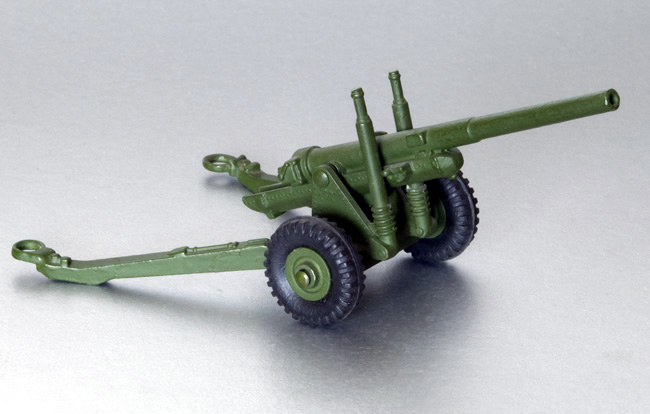 Perhaps we should just call them Hubs not Supertoy Hubs Dave
Please Log in or Create an account to join the conversation.
11 years 10 months ago #15037
by Dinkinius
Replied by Dinkinius on topic 622 Foden 10 ton Army truck (1954-64)
Good Grief Dave!! I had completely forgotten that the 692 was shod with Supertoy hubs! :lol: I knew the 693 had the same hubs as the 965, 437, etc. but I had completely forgotten about the 692. Call them Hubs with the capital 'H'? Mmmmmm, perhaps grooved hubs for them, ridged for the remainder, spun, etc. But we digress! Today is a nice (but expected high temperature day of 38 degrees!  ) So will have to be quick with my natural lighting photography of the chassis to cab differences between the 1st and 3rd Versions of the 622. Bruce
) So will have to be quick with my natural lighting photography of the chassis to cab differences between the 1st and 3rd Versions of the 622. BrucePlease Log in or Create an account to join the conversation.
11 years 10 months ago #15038
by Dinkinius
Replied by Dinkinius on topic 622 Foden 10 ton Army truck (1954-64)
Further to my previous post, here are several images showing the casting change at the rear of the cab where it meets the chassis. This what I wrote previously: ADDITIONAL CASTING DIFFERENCE BETWEEN VERSION 1 AND VERSION 2 Anyway, I have had another closer look at my smooth roofed 622 and I have noticed there is a casting difference behind the cab onto the chassis. In the Version 3, there is a large, slightly curved section from the cab to the chassis with a small section in the middle that is lower. In Version 1, the cab itself is slightly curved as it meets the chassis and on each end is a smaller slightly curved extension that meets the edge of the upper chassis. It might be my imagination, but the distance between the cab and the cargo 'tray' seems minutely longer on the smooth roof version, about .5 to 1mm. Faint outlines of the roof side ridges can be seen as well as the commencement of the centre ridge, which may be noticeable on the pictures I have posted. The roof itself is not completely smooth either.I will try to take some photographs that hopefully show the casting difference behind the cab and hopefully the distance difference as well and I will add them to this post.
 Please excuse the poor casting of the driver's door for the Version 2 model on the left!

 I am sorry if these images are not crystal clear and sharp as a tack, but my camera does have limitations for close-up photography. However one thing is apparent, the purpose of this feature is to strengthen the chassi-cabin in the same way as other models, the Bedford O series, and the Euclid to name a couple. Kind regards Bruce
Please Log in or Create an account to join the conversation.
11 years 10 months ago #15044
by janwerner
Replied by janwerner on topic 622 Foden 10 ton Army truck (1954-64)
Coming back a moment to the hubs, if you don't mind: I think the Medium Gun's hubs/tyres meet expectations, as do for example the ones of the Armoured Command Vehicle. The hubs/tyre size 'ratio' is alright - even though they are baptized as Dinky Toys. The Foden remains a real exception, with its (post-1952 used) ridged hubs and large tyres. The other ridged hubs exceptions are the 1950s racers, but I believe that is a matter of scale, because they are 1:38 (and in fact some of their wheels are a tiny bit too large due to the use of the large 20mm tyres). By the way, Dave, your photo of the Medium Gun shows nicely that the whole model has been sprayed after complete assembly - see the axle ends. Kind regards, Jan
Please Log in or Create an account to join the conversation.
11 years 10 months ago #15051
by buzzer999
Replied by buzzer999 on topic 622 Foden 10 ton Army truck (1954-64)
Whilst doing some research into post war military vehicles earlier this year I spent a lot of time with a curator at the REME Museum in Arborfield. He told me that the Army used the Doden DG extensively in WWII, but only ever had two of the post-war vehicles on trial but they never went into service. The army chose the AEC Militant.
 Here is the Foden taken from Page 91 of 'The Observer's Fighting Vehicles Director World War II' Note the relative size of the wheel hubs and tyres. The tyres are particularly chunky. Dinky had a dilemma when introducing the Foden to the military range in 1954. With their 'big Foden' range (901.902etc.) they had already changed from the Type 1 cab to the Type 2 cab so they would have felt it a retrograde step to do the military version with a Type 1 cab. They obviously chose the more modern cab on the military version rather than base it on a wartime vehicle. In retrospect Dinky might have been basing this vehicle on the AEC truck. Going back to the choice of hubs, to get the desired chunky appearance they used ordinary hubs and large tyres. All this of course is conjecture but it does make sense. Dave
Please Log in or Create an account to join the conversation.
11 years 10 months ago #15056
by Dinkinius
Replied by Dinkinius on topic 622 Foden 10 ton Army truck (1954-64)
buzzer999 wrote: 'Whilst doing some research into post war military vehicles earlier this year I spent a lot of time with a curator at the REME Museum in Arborfield. He told me that the Army used the Doden DG extensively in WWII, but only ever had two of the post-war vehicles on trial but they never went into service. The army chose the AEC Militant. Here is the Foden taken from Page 91 of 'The Observer's Fighting Vehicles Director World War II' Note the relative size of the wheel hubs and tyres. The tyres are particularly chunky. Dinky had a dilemma when introducing the Foden to the military range in 1954. With their 'big Foden' range (901.902etc.) they had already changed from the Type 1 cab to the Type 2 cab so they would have felt it a retrograde step to do the military version with a Type 1 cab. They obviously chose the more modern cab on the military version rather than base it on a wartime vehicle. In retrospect Dinky might have been basing this vehicle on the AEC truck. Going back to the choice of hubs, to get the desired chunky appearance they used ordinary hubs and large tyres. All this of course is conjecture but it does make sense. Dave' Dave What you wrote about Meccano's choice of tyres and hubs, bearing in mind that this, as you wrote, is all pure conjecture, matches my comments a little earlier: '. . . one factor that may have influenced Meccano to use the ridged hubs on the 622, is that the size of tyres coupled with the ridged hubs gives the impression of an even larger, off-road tyre, more 'real' as the Army trucks out here (most likely the same in the UK) always had larger 'balloon' type tyres, to manage sand, mud etc. ' Bruce
Please Log in or Create an account to join the conversation.
- dinkycollect
-
 Topic Author
- Offline
- User
-

Less
More
- Thank you received: 0
11 years 10 months ago #15058
by dinkycollect
Replied by dinkycollect on topic 622 Foden 10 ton Army truck (1954-64)
Do I understand exactly what David has writen ? There were some trucks with the type one cab in the Army before the war and only two were build for evaluation with the type two cab like the Dinky. Meccano France did the same with the 80 d Camion militaire Berliet only one or two have been build by Rochet Schneider but Berliet got the order for a variation. Meccano modeled the prototype and not the production model.
Please Log in or Create an account to join the conversation.
11 years 10 months ago #15059
by buzzer999
Replied by buzzer999 on topic 622 Foden 10 ton Army truck (1954-64)
I will try to explain this better. The dinky Foden that was introduced in 1947 as catalogue number 501 is what we all know as the 'Type 1' cab, this was a vehicle introduced by Foden during WWII. What we know as the 'Type 2' cab was a post-war Foden vehicle. Dinky obviously wanted to introduce a six wheeler to the military range and they chose the Foden. This was their dilemma; did they use an obsolete cab which had been in use by the military for some years, or did they use the current cab which the military had chosen not to adopt. Whilst I love the post-war range of military vehicles more than any other range of Dinky Toys I cannot see the logic in what they actually made. Dave
Please Log in or Create an account to join the conversation.
- dinkycollect
-
Topic Author
- Offline
- User
-
Less
More
- Thank you received: 0
11 years 10 months ago #15060
by dinkycollect
Replied by dinkycollect on topic 622 Foden 10 ton Army truck (1954-64)
David, Thank you for clarifying. Meccano probably has good contacts with Foden and not with AEC at that time. My opinion is that models of vehicles that one sees on the road are more popular than many very nice models which one has never seen before.
Please Log in or Create an account to join the conversation.
11 years 10 months ago #15061
by buzzer999
Replied by buzzer999 on topic 622 Foden 10 ton Army truck (1954-64)
Absolutely correct Jacques There are many conundrums, why did Dinky never do a model of the Morris 1000 or the Ford Thames. Two incredibly popular vehicles seen every day on overy road and street. I feel a new thread coming on for the vehicles Dinky never had in their range. I will kick it off later today or tomorrow. Dave
Please Log in or Create an account to join the conversation.
Time to create page: 3.405 seconds
