
- Thank you received: 0
702 D.H. Comet Airliner (1954-1965)
- dinkycollect
-

- Offline
- User
-

Less
More
10 years 8 months ago #17796
by dinkycollect
Replied by dinkycollect on topic 702 D.H. Comet Airliner (1954-1965)
Yes Bruce, great. Thank you. Jacques (#100)
Please Log in or Create an account to join the conversation.
- binnsboy650
-

- Offline
- User
-
Less
More
- Thank you received: 0
8 years 7 months ago #20443
by binnsboy650
Replied by binnsboy650 on topic 702 D.H. Comet Airliner (1954-1965)
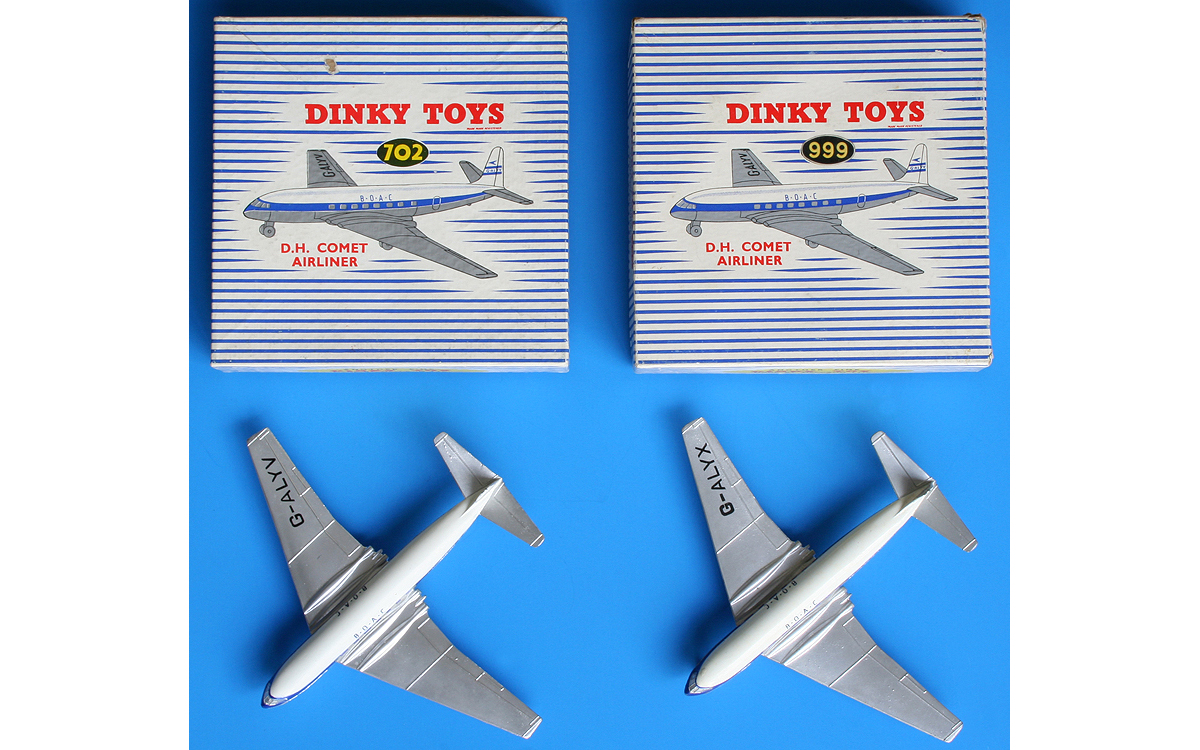
Hi everyone and a Happy New Year! Most of you will have read Jan Werner's article on the 702/999 De Havilland Comet on the Talk Model Toys forum and, like me, have wondered why it was not possible to cut-and-paste it here. I felt that it was worth the effort to try again so I shall now make the attempt. As I said to Jan, we shall know shortly whether I have been successful! Here goes! JohnDear Dinkyclub friends, I had the idea that this nice and historical model deserved more attention than it had up till now. So Ill try to make an introduction for a discussion. (Oops, a bit long. If the size is too big, please consider this contribution as a kind of Easter bonus) The Dinky (Super-) Toys no. 702 / 999 D.H. Comet Airliner had a considerably more successful life than its real-world counterpart, the De Havilland Comet I, the first operational jetliner in the world. Following six crashes the plane was forbidden to fly. Only one of these accidents seems to have been due to a human error, the others were due to the plane, especially problems with fatigue and the pressure compartment. dead link The model consists of two main diecast components (as usual for most Dinky planes of this size), the upper half of the fuselage with the tail, and the lower half of the fuselage with the main wing(s) and main landing gear, bolted together. dead link Contrary to the French larger planes, the blue band, which stretches at both sides from the nose section back to the tail of the model, has been painted instead of using transfers. dead links Until ca. 1955 the registration number of this Dinky Comet, applied on the starboard wing and both sides of the tail fin, was G-ALYV. Then it was changed into G-ALYX. In this year the model itself was renumbered as well, from 702 (in the original aircraft number range) to the high Dinky Supertoys number 999. dead links Some old stock of no. 702 Dinky Toys boxes were given the 999 number by applying neat little red and black oval stickers over the old numbers on the boxes. dead link The renumbering was applied to the die as well. On raised cartouches (deepened in the die) the changed brand name wording Dinky and Supertoys appeared under the starboard wing and the new number 999 under the port one. The wheels, which were made in a rather yellowish finish in the beginning, made a change into a more white metal appearance then. In their second bible the Richardsons explain that the registration number change took place in 1959/60, but that would not agree with the box presented here, which must have been combined with the model inside sometime not too long after the renumbering and Supertoys change in 1955. I have seen other apparently authentic box/model combinations like this one. Besides, as it would have been reasonable that the change into ALYX should have been made even before the introduction of this model (see above), it is also plausible in my opinion that the models were finished that way a lot earlier than the marketing pictures show. Indeed, the pictures on boxes, folders and in catalogues with the old registration number are rather persistent. Some of them here: dead links 1963 The 1962 catalogue picture and its setting is rather remarkable, as the artwork below shows the innovated Comet 4B in the new BOAC finish with blue tail, whereas the model shown is of course the available, old-fashioned, ill-fated Comet 1. dead link Around 1964 the silver finish was replaced by grey metallic and at last the tail wings and fin got the modern dark blue colour, which the actual early 1950s plane of course never had. Some pictures of the model (like the above) seem to indicate that also new transfers were applied with the more narrow wording B.O.A.C. They seem to be discoloured sometimes, which may indicate that they were water based, like the French ones, rather than the bright sprit based ones. Somebody of you may explain or comment on this, I have no such examples. The wing registration numbers seem to have become heavier, fatter too. dead links The box was adjusted every now and then according to the fashion of the Dinky boxes. Apart from the designs shown above I presume there are also striped boxes with straight DINKY TOYS characters but PRINTED nos. 999, and boxes with straight and later italic DINKY SUPERTOYS print. dead link The model was prevented from moving too much in the box by a wrap-around piece of card board, with flat openings to hold the wing tips in place. dead link Still, one can hardly find an example of this model which does not suffer from rubbing paint damage on top of the tail fin, which hits the inside of the box lid permanently. In fact this happens with most of the plane models, but it is more obvious on the ones with a white painted tail. dead link The Nicky Toy (courtesy Christiaan Boland for lending this picture which he posted in the Nicky section) Although the model was deleted after eleven years in 1965, its life had not ended yet. The die was sold to India in 1968, in order to be used for producing the Nicky Toys Comet. Although the lettering on the transfers remained the same, new transfers seem to have been introduced again then. Only the tail fin (and of course the blue band along the fuselage) remained blue in finish, the rest of the tail plane wings turned into silver again. This final version also had fewer cabin windows and Nicky continued the original Dinky catalogue number 999. dead links The Comet model was really a good job, a faithful reproduction as it is of the real plane (with all restrictions of the time and Dinky style), with correct details (as far as reproduced). The models nose cone witnesses the similarity with the nose of the French Caravelle, which both of them shared in reality. However, there is some dissimilarity in the detailing of the cockpit windows, of which the French ones admittedly are better in concordance with reality. dead links
The small pointy extensions between both couples of the jet engine exhausts represent the exhausts of two Sprite rocket engines, which were meant to provide extra thrust power during take off. They were never implemented (but still present in shape) in regular production type 1 Comets. Points of critique could be the rather crude landing gear and the too flat elliptical air intakes for the engines. Also the rather obvious seam between the two halves, especially the one behind the cockpit is not an aesthetical success (see picture above). dead links The real one with the first registration number, which crashed before the Dinky model was introduced (from: toxic link The real Comet of this (first) type was a big failure, as commented already. Only 11 of this type (suitable for 36 passengers) were delivered. The first flight was in 1949, and it entered service in 1952, but it was kept aground in 1954 already, after six fatal crashes and it would never take off again in its original design. I think its most curious that the dramatic disasters with this plane apparently did not prevent Meccano from continuing the production and marketing of this Dinky model, and the buyers equally did not care much either, because a period of more than ten years (1954-1965) must be considered to have been a very satisfactory time span for the sales of this model. The fact that it is far from rare nowadays may confirm high production numbers. dead link The renewed D.H. 106 Comet 4B The model could not only give rise to unpleasant associations, it was also outdated very quickly, as the real one was deleted in 1954, and the considerably better Comet 4 - with obvious differences, especially in length, extra external fuel tanks on the wings, and much smaller fatigue resistant cabin windows - was introduced in 1958. So the Dinky model was still popular some ten years after several disasters and the actual withdrawal of the plane, and the children played happily with the model of a very dangerous but nevertheless beautiful - aeroplane! The only adaption implemented by Meccano was the change of the registration number of one of the crashed planes (G-ALYV, crashed already on 2 May 1953 near Calcutta, a long time before the Dinky was in the shops, in October 1954) into a new one (G-ALYX). The real G-ALYX was delivered in July 1952, but it was scrapped only three years after, in June 1955. More about the Dinky Comet in Sue Richardsons Diecast Toy Aircraft and on the very good site toxic link. Diagram details from : Straalverkeersvliegtuigen (Haarlem : Oberon, 1981). Kind regards, Jan Werner PS: I do not have a record of the October 1954 Meccano Magazine. I am most curious about the review of this model in relation to the dramatic crashes (The Toyman most probably will have been very enthusiastic and positive about it, as usual). Perhaps somebody of the club can reproduce that review in this thread?
The small pointy extensions between both couples of the jet engine exhausts represent the exhausts of two Sprite rocket engines, which were meant to provide extra thrust power during take off. They were never implemented (but still present in shape) in regular production type 1 Comets. Points of critique could be the rather crude landing gear and the too flat elliptical air intakes for the engines. Also the rather obvious seam between the two halves, especially the one behind the cockpit is not an aesthetical success (see picture above). dead links The real one with the first registration number, which crashed before the Dinky model was introduced (from: toxic link The real Comet of this (first) type was a big failure, as commented already. Only 11 of this type (suitable for 36 passengers) were delivered. The first flight was in 1949, and it entered service in 1952, but it was kept aground in 1954 already, after six fatal crashes and it would never take off again in its original design. I think its most curious that the dramatic disasters with this plane apparently did not prevent Meccano from continuing the production and marketing of this Dinky model, and the buyers equally did not care much either, because a period of more than ten years (1954-1965) must be considered to have been a very satisfactory time span for the sales of this model. The fact that it is far from rare nowadays may confirm high production numbers. dead link The renewed D.H. 106 Comet 4B The model could not only give rise to unpleasant associations, it was also outdated very quickly, as the real one was deleted in 1954, and the considerably better Comet 4 - with obvious differences, especially in length, extra external fuel tanks on the wings, and much smaller fatigue resistant cabin windows - was introduced in 1958. So the Dinky model was still popular some ten years after several disasters and the actual withdrawal of the plane, and the children played happily with the model of a very dangerous but nevertheless beautiful - aeroplane! The only adaption implemented by Meccano was the change of the registration number of one of the crashed planes (G-ALYV, crashed already on 2 May 1953 near Calcutta, a long time before the Dinky was in the shops, in October 1954) into a new one (G-ALYX). The real G-ALYX was delivered in July 1952, but it was scrapped only three years after, in June 1955. More about the Dinky Comet in Sue Richardsons Diecast Toy Aircraft and on the very good site toxic link. Diagram details from : Straalverkeersvliegtuigen (Haarlem : Oberon, 1981). Kind regards, Jan Werner PS: I do not have a record of the October 1954 Meccano Magazine. I am most curious about the review of this model in relation to the dramatic crashes (The Toyman most probably will have been very enthusiastic and positive about it, as usual). Perhaps somebody of the club can reproduce that review in this thread?
Please Log in or Create an account to join the conversation.
- binnsboy650
-
- Offline
- User
-
Less
More
- Thank you received: 0
8 years 7 months ago #20444
by binnsboy650
Replied by binnsboy650 on topic 702 D.H. Comet Airliner (1954-1965)
Well that worked! Here is the URL of the google books page for Graham M. Simons' book 'Comet! The World's First Jet Airliner', which has the full story of this ground-breaking (no pun intended) aircraft.
books.google.co.uk/books?id=qN07BAAAQBAJ...y%20film&f=false
Please Log in or Create an account to join the conversation.

8 years 7 months ago #20445
by janwerner
Replied by janwerner on topic 702 D.H. Comet Airliner (1954-1965)
Thanks, John, for copying this. it's an account of many years ago,so I hope it still makes some sense. Kind regards, Jan
Please Log in or Create an account to join the conversation.

8 years 7 months ago #20447
by dinkyfan
Replied by dinkyfan on topic 702 D.H. Comet Airliner (1954-1965)
JanI , of course, had already read some time ago, your excellent write up on the Comet, on Talk Model Toys, but I thoroughly enjoyed reading it again....a testament to the thoroughness of your writing. It does seem a bit strange for Dinky to press on with production of such an ill-fated airplane, but I can only guess that due to the extremely good looking design of that prototype, maybe Meccano decided it would be popular and sell well anyway. I can only say that here in the US, I grew up totally ignorant of the real Comet and its sad history, but I loved the Dinky model, as did many other young collectors. Even looking today, I still think the Comet was one of the most attractive airliners ever built, and maybe Meccano played on that theme with producing it for so long. Best regards, Terry
Please Log in or Create an account to join the conversation.
8 years 7 months ago #20448
by janwerner
Replied by janwerner on topic 702 D.H. Comet Airliner (1954-1965)
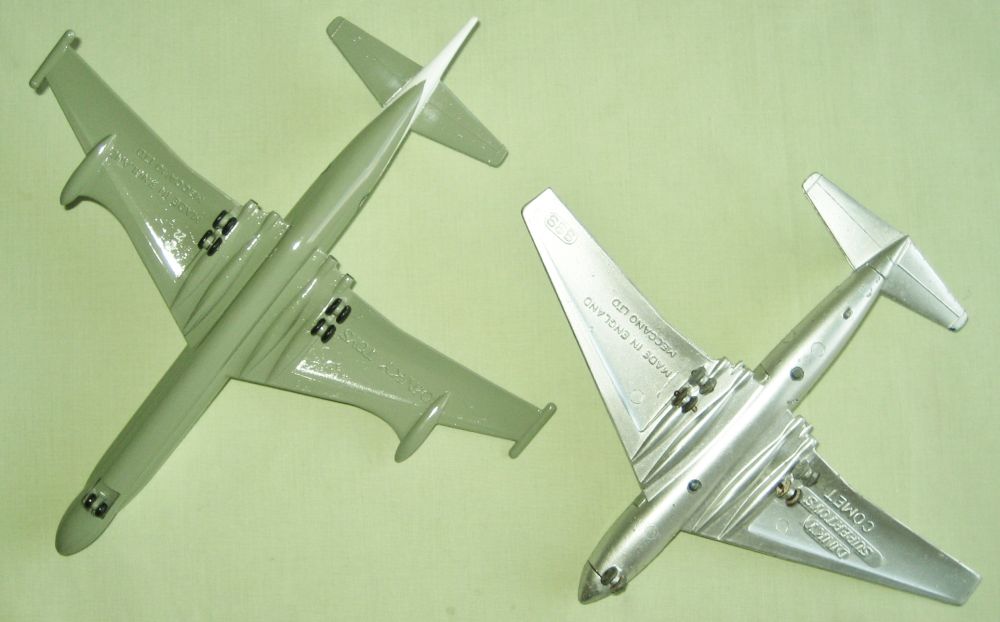
Many years later I found a nice example of the G-ALYV and made the comparative photo couple below. Kind regards, Jan

Please Log in or Create an account to join the conversation.
7 years 2 months ago #21542
by Chris1
Replied by Chris1 on topic 702 D.H. Comet Airliner (1954-1965)
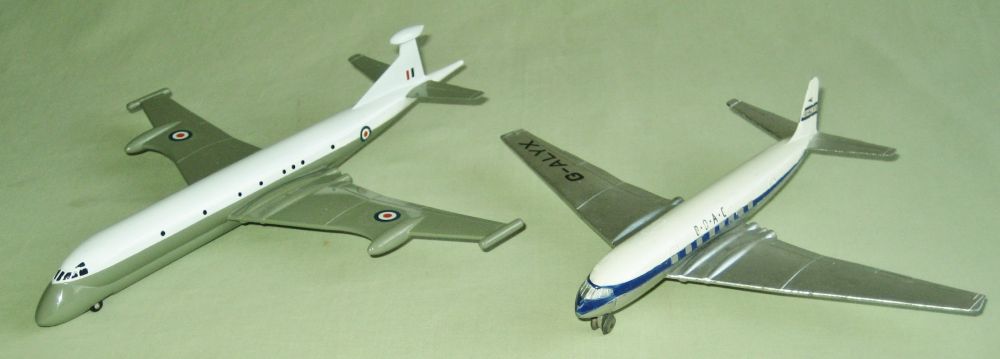
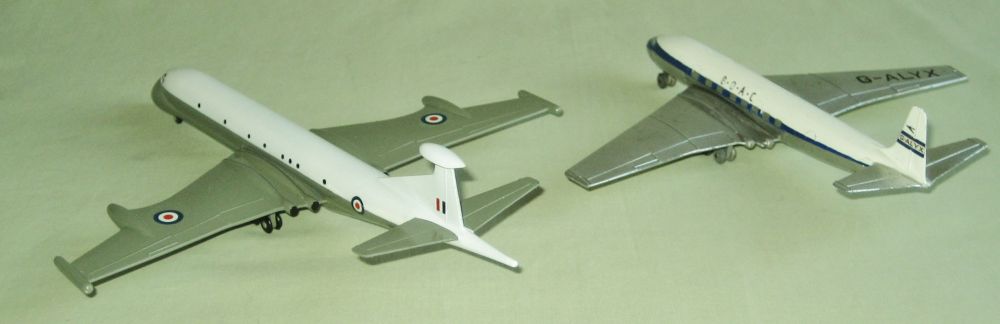
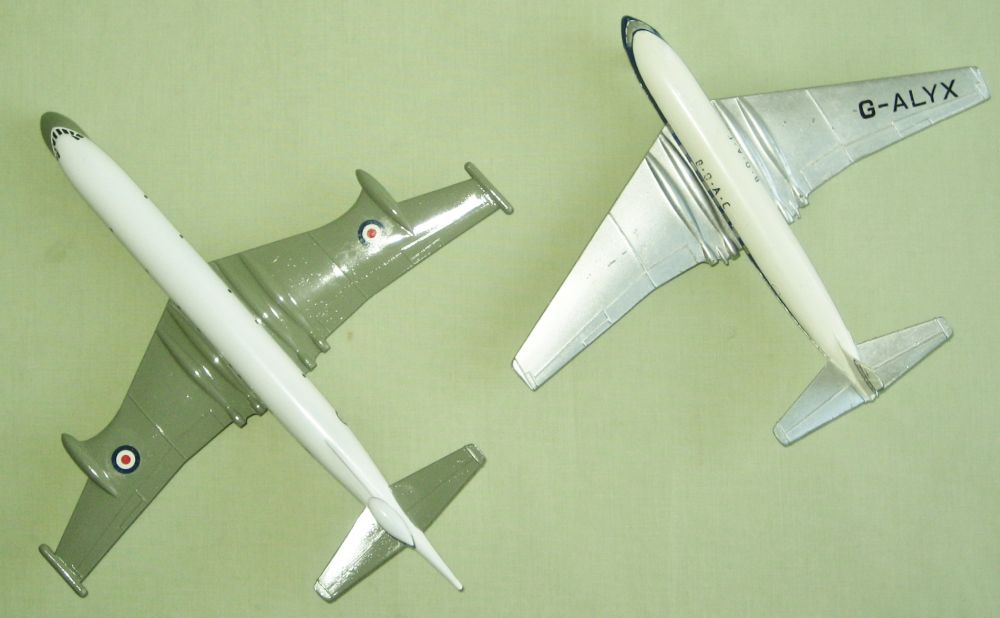
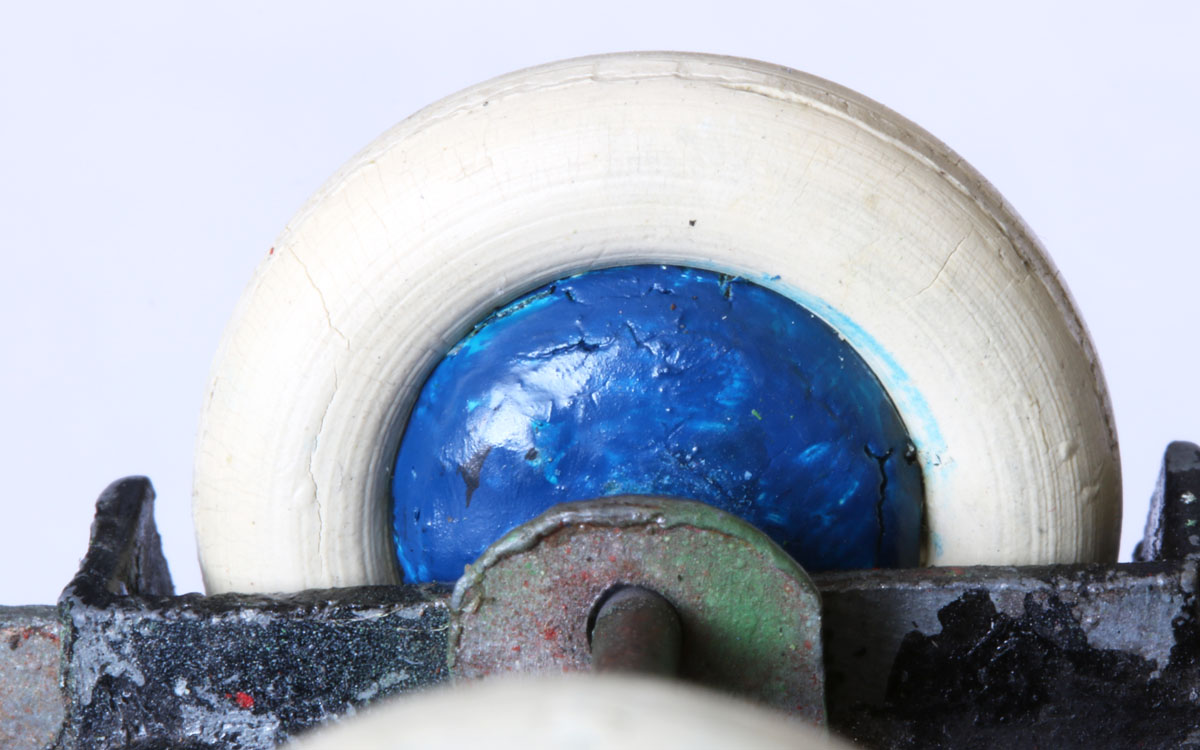
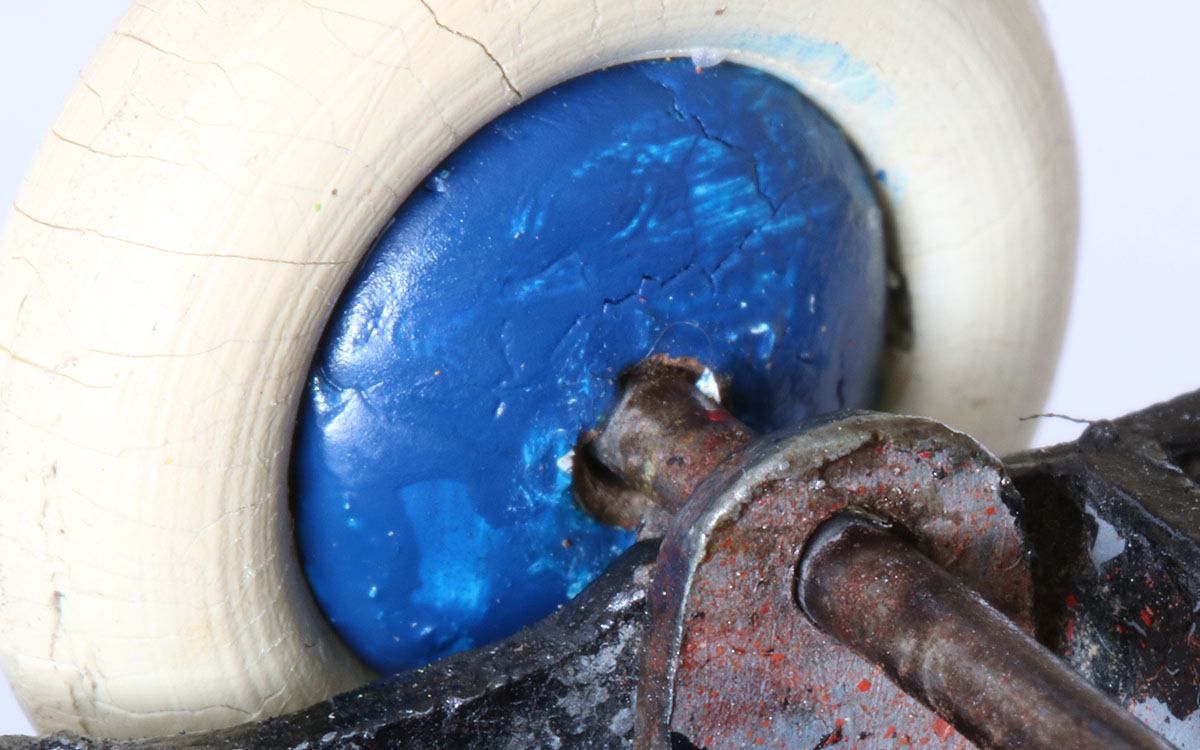
I have been lucky enough to acquire this code 3 conversion of the Dinky Comet aircraft made by John Alcott. These conversions were only made in small numbers and are hard to find. As can be seen from the photographs the model has been heavily modified with an extended fuselage, a changed wing design with fuel tanks and a changed tail design. There are also electronic and radar fairings and a changed nose wheel configuration. The quality of the finish is superb. This particular example is signed under the wing 'JA 22'. The original designation 'DINKY TOYS' and 'Made in England Meccano Ltd' remains under the wings. Photographs of more of John Alcotts conversions can be seen in the book 'Dinky Toys Aircraft 1934-1979' by GR Webster on page 73. Chris


Please Log in or Create an account to join the conversation.
7 years 2 months ago #21543
by dinkyfan
Replied by dinkyfan on topic 702 D.H. Comet Airliner (1954-1965)
So that was a later version of the original Comet? Did it last long in service, and so you know service dates? It looks to be superbly modified and finished.....very nice! Best regards, Terry
Please Log in or Create an account to join the conversation.
7 years 2 months ago #21544
by Chris1
Replied by Chris1 on topic 702 D.H. Comet Airliner (1954-1965)
Terry, As I understand from a Wickipedia entry the Nimrod Maritime Patrol aircraft was in service from 1969 until 2010. They were used for Anti Submarine warfare, as an airborne early warning platform and search & rescue operations.The aircraft were based on the Comet 4. Chris.
Please Log in or Create an account to join the conversation.
6 years 6 months ago #21910
by janwerner
Replied by janwerner on topic 702 D.H. Comet Airliner (1954-1965)
An example below of the final version with new BOAC tail transfer and grey metallic finish (+ new yellow richly illustrated box), which landed on my private airport a few days ago. It is striking that the box illustration shows the old white BOAC tail, whereas a previous blue striped box shows the new all-blue tail (see post #24 above). Kind regards, Jan


Please Log in or Create an account to join the conversation.
Time to create page: 2.195 seconds
